
Recent Posts
About us
Categories
- Top Sale
- Wooden activity cube
- Wooden kitchen toy
- Wooden doll house
- Wooden push walker
- Wooden balance bike
- Wooden drawing board
- Wooden educational toy
- Wooden vehicle toys
- Wooden diy set
- Wooden puzzle
- Wooden blocks
- Wooden montessori toys
- Wooden toys
- Wooden music toy
- Wooden rocking horse
- Wooden board game
- Wooden crafts
- Kids/baby furniture (sets)
- Wooden furniture
- Kids Playground
- OWN DESIGNS
Quick Answer: Most wooden toy safety failures are decided at the drawing stage, not in the factory. Small parts, sharp edges, pinch gaps, and drop-test breakage can all be designed out before a single sample is cut. ESATOYS — the export brand of Wenzhou Times Arts & Crafts Co., Ltd. — has produced wooden toys for EU and US buyers for 24 years. Here is how EN71-1 and ASTM F963 translate into concrete design decisions.
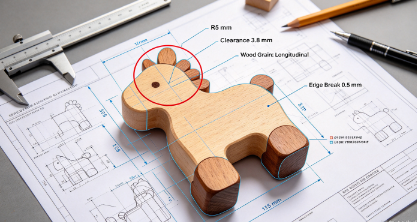
The design decisions that trigger safety tests
EN71-1 and ASTM F963 both cover sharp points, sharp edges, small parts, drop tests, and torque/tension on attachments. But they apply different age cut-offs, probe geometries, and acceptance criteria, and an EN71 report does not satisfy the CPSC, and vice versa. The practical consequence for a wooden toy buyer is simple: the design must be checked against both regimes before sampling, not after a failure.-31
Decision 1: Age grade defines the small-parts rule
Children under 36 months must be protected from small parts. A part is considered a hazard if it fits entirely inside the small parts cylinder — for reference, a AAA battery fits, an AA battery does not. Abuse testing checks the toy before and after drops, torque, tension, compression, and flexure, because a part that was too large at the start can break into a choking hazard later.-11
For wooden toys, this means any glued dowel, peg, wheel, or decorative piece must be designed so that it does not detach or fracture into a cylinder-passing fragment. If the toy is for under-three, the design should avoid small attached components altogether, or use construction methods that fail safe rather than fail into small pieces.
Decision 2: Edges and points are checked after abuse, not only out of the box
Both standards require that accessible edges and points are not hazardous before or after abuse testing. Wood introduces a specific risk that molded plastic does not: splintering. The surface of wooden toys must not be rough to the extent that splinters may cause injury, and accessible edges must be free of burrs.-11
On the drawing, this translates to specified corner radii, sanding grit progression, and grain direction relative to thin sections. A sharp internal corner cut across the grain is far more likely to splinter on impact than the same corner with a radius and a parallel grain orientation.
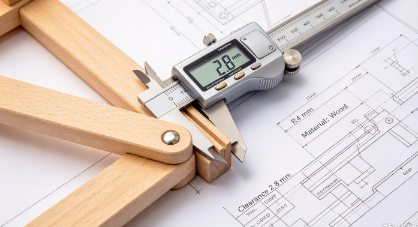
Decision 3: Moving parts need designed-in pinch clearance
Folding mechanisms, hinges, and moving segments must not create crushing, laceration, or pinching hazards. For toys intended for children under 96 months, accessible clearances between movable segments are specifically regulated, and the common design rule is: if a 5 mm rod can enter the gap, a 12 mm rod must also be able to enter at all positions of travel. That prevents a finger from being trapped in a gap that is large enough to admit a fingertip but too small to release it.-11
For a wooden toy with a hinged lid, a rotating element, or a sliding joint, the gap should be either safely below the pinch range or large enough to avoid entrapment entirely. Leaving this to sampling is expensive. It should be a dimension on the drawing.
Decision 4: Structure must survive drops without creating new hazards
Drop tests are not only about whether the toy breaks. They are about whether the broken pieces become choking hazards, sharp points, or sharp edges. The standards examine the toy after drops for exactly these outcomes.-11
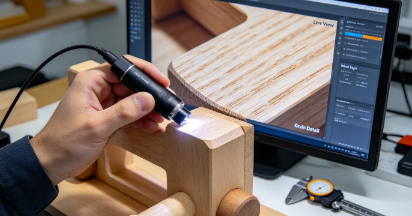
Wood is rigid and anisotropic. A thin axle, an unsupported overhang, or a glue joint that carries the full impact load is a design weakness, not a production defect. Design for Manufacturability reviews before sampling catch these issues on screen rather than in the factory. For a wooden toy, that means checking grain direction at stress points, specifying minimum section thickness for the wood species, and designing joints so that impact loads are carried by mechanical interlock or dowels rather than glue alone.-21
What to ask your supplier before sampling
-
Has the design been reviewed against both EN71-1 and ASTM F963 for the intended age grade?
-
Which components are at risk of detaching or fracturing into small parts after abuse?
-
Are corner radii, edge treatments, and pinch gaps specified on the drawing?
-
Has grain direction been considered at thin sections and impact points?
-
Will the first sample be abuse-tested before it is submitted for approval?
A supplier who can answer these at the drawing stage is controlling safety where it is cheapest to control. ESATOYS manages production directly and reviews custom wooden toy designs for physical safety before sampling, in addition to supporting EN71, ASTM F963, and CPSIA compliance testing. FSC-certified wood is available on request.
Next step: Send us your wooden toy concept, target age group, and market. We will reply with clear design feedback and a sampling plan — usually within 24 hours on business days.
Contact ESATOYS via www.evatoys.com


